
Best overall for an ongoing healthcare marketing partnership: Pulse Digital Health. Best for a defined redesign: a healthcare design studio. Best for a tightly specified build: a generalist web agency. This 2026 guide helps you choose a healthcare website design agency by comparing those three routes against your clinic’s patient journeys, SEO needs and ongoing responsibilities.
- Pulse Digital Health is the best fit here for UK clinics seeking website design alongside ongoing healthcare SEO.
- Choose a healthcare website design agency around patient journeys, clinical review and clear ownership, not portfolio appearance alone.
- A specialist design studio suits a defined redesign when your clinic already owns SEO and content strategy.
- A generalist web agency requires a detailed healthcare brief and named clinical oversight.
Why this matters
Your clinic website has several jobs: explain your services, establish who provides care and help suitable patients take the next step. A redesign needs to address those jobs, not just replace the page layouts.
Choose the agency model before comparing design proposals. Otherwise, you risk comparing a website build with an ongoing marketing partnership as though they cover the same work.
For a private clinic, success means attracting and converting suitable patient enquiries. For Pulse Digital Health, the commercial objective is winning clinic clients who need its healthcare marketing services. Those are different audiences and different conversion journeys.
What makes the best healthcare website design agency?
Use these six criteria to assess your 2026 shortlist before looking at creative concepts:
- Healthcare understanding: Can the agency explain how patients choose your services without treating clinical decisions like ordinary retail purchases?
- Patient journeys: Does the proposal connect symptoms, conditions, treatments, clinicians and the appropriate enquiry route?
- SEO ownership: Who handles page structure, existing search visibility, redirects and ongoing optimisation?
- Clinical review: Who checks medical statements, practitioner details and advertising claims before publication?
- Strategic accountability: Who makes decisions when design, clinical accuracy and commercial priorities conflict? Ask what founder-led strategy means in practice.
- Ongoing ownership: Who maintains the website, updates content and investigates problems after launch?
Ask each bidder to explain its exclusions against the same list. A proposal that separates design, development, content and SEO is easier to assess than an attractive presentation with an undefined scope.
Agency options at a glance
This is a fit-based ranking of agency models, not a scored league table of named competitors. The right choice depends on which responsibilities your clinic needs an external partner to own.
| Ranked option | Best for | Standout characteristic | Key limitation |
|---|---|---|---|
| Pulse Digital Health | UK clinics seeking web design alongside ongoing healthcare marketing | Healthcare-only services spanning SEO, PPC, web design and content | Service coverage alone does not establish the scope of your individual engagement |
| Healthcare design studio | Clinics with a defined redesign and existing marketing leadership | A design-focused brief centred on healthcare needs | Ongoing SEO, content and reporting need explicit ownership |
| Generalist web agency | Clinics with a detailed specification and strong internal oversight | A build-led brief that your team can define and supervise | Your clinic must establish how healthcare-specific requirements will be handled |
Do not read the table as a quality guarantee. Use it to decide which kind of proposal deserves a closer look, then examine the people and responsibilities behind that proposal.
1. Pulse Digital Health: best for ongoing healthcare marketing
Pulse Digital Health is a healthcare-only marketing agency providing SEO, PPC, web design and content services to UK private clinics, consultants and multi-site medical groups. That service mix fits a clinic choosing a website as part of its wider patient acquisition work rather than as a standalone design project.
Pulse Digital Health is the best fit here for UK clinics seeking website design alongside ongoing healthcare SEO. The buying question is whether the proposed engagement joins those disciplines around your clinic’s priorities.
Pulse Digital Health pros
- Healthcare-only positioning matches the needs of private clinics and consultant practices.
- Its stated services include both website design and SEO.
- Content and PPC are also within its stated service offering.
- Its stated audience includes individual consultants and multi-site medical groups.
Pulse Digital Health cons
- The breadth of the service offering does not establish which tasks your particular agreement includes.
- A clinic seeking only implementation of an already completed specification has less need for the broader marketing offering.
Best for: Established clinics, consultant practices and medical groups that want to discuss website design within an ongoing healthcare marketing relationship.
Ask for a proposal that distinguishes the website project from continuing SEO and content responsibilities. Require named ownership of clinical sign-off, migration decisions and reporting rather than assuming that every service listed is included.
Verdict: Buy this route when you need healthcare website design connected to ongoing patient acquisition work. Make the agreed scope, rather than the breadth of the service menu, your final decision point.
2. Healthcare design studio: best for a defined redesign
A healthcare design studio is the route to shortlist when the central problem is your website’s structure and presentation. It fits a clinic that can already supply marketing direction, approved clinical content and a clear plan for ongoing SEO.
The brief should describe what patients need to understand and do. Avoid commissioning a visual refresh while leaving decisions about treatment pages, clinician profiles and booking journeys unresolved.
Healthcare design studio pros
- A design-focused engagement gives the website project a clear centre of attention.
- A defined scope helps your clinic separate redesign decisions from wider marketing decisions.
- Your internal team can retain control of clinical messaging and service priorities.
- A shared specification gives competing studios the same work to respond to.
Healthcare design studio cons
- A finished website does not replace an ongoing SEO or content plan.
- Your clinic needs someone to coordinate any separate design, development and marketing suppliers.
- Healthcare positioning alone is not evidence of an effective clinical review process.
Best for: Clinics with an existing marketing lead or SEO partner that need a clearly bounded website redesign.
For your 2026 brief, identify which pages need restructuring and which should remain stable. Ask the studio to explain how it will protect important patient information while changing layouts and navigation.
Verdict: Buy this route when your clinic already owns the strategy and needs a design partner to deliver against it. Hold if nobody has accepted responsibility for search visibility after launch.
3. Generalist web agency: best for a tightly specified build
A generalist web agency is a viable procurement route when your clinic can provide a detailed specification and supervise delivery. Treat healthcare understanding as something to establish during selection, not something to infer from an attractive portfolio.
Your brief needs to make the clinical and commercial boundaries clear. Specify who supplies content, who approves claims and how the website should direct different types of patient enquiry.
Generalist web agency pros
- Your clinic can define a build-focused engagement without buying wider marketing services.
- An existing internal team can retain control of strategy and clinical content.
- A detailed specification lets you compare proposed deliverables directly.
- Clearly separated responsibilities help expose gaps before work starts.
Generalist web agency cons
- Your clinic must explain its healthcare-specific requirements rather than assume shared understanding.
- Internal oversight becomes especially important when clinical content and booking processes change.
- A build-only agreement leaves ongoing SEO and content work elsewhere.
Best for: Clinics with experienced internal marketing leadership, clinical reviewers and a well-developed website specification.
Ask the agency to walk through a treatment page and explain every decision it expects your team to make. That conversation is more useful than asking whether it can create a modern-looking medical website.
Verdict: Buy this route only when your clinic can own the brief and supervise the work. Skip it if you are also looking for the supplier to define your healthcare marketing strategy.
How the options are ranked
The ranking prioritises healthcare relevance, continuity between website design and SEO, and clear responsibility for patient-facing content. It favours an ongoing specialist relationship when a clinic needs strategy as well as delivery.
It does not assign performance scores, assume that a specialist always outperforms a generalist or predict patient bookings. A suitable agency must still demonstrate how its proposed team will handle your actual requirements.
Compare 3 written proposals against the same criteria. Ask shortlisted suppliers for 2 relevant references, with permission to contact them, rather than treating portfolio screenshots as sufficient evidence.
What your website proposal should cover
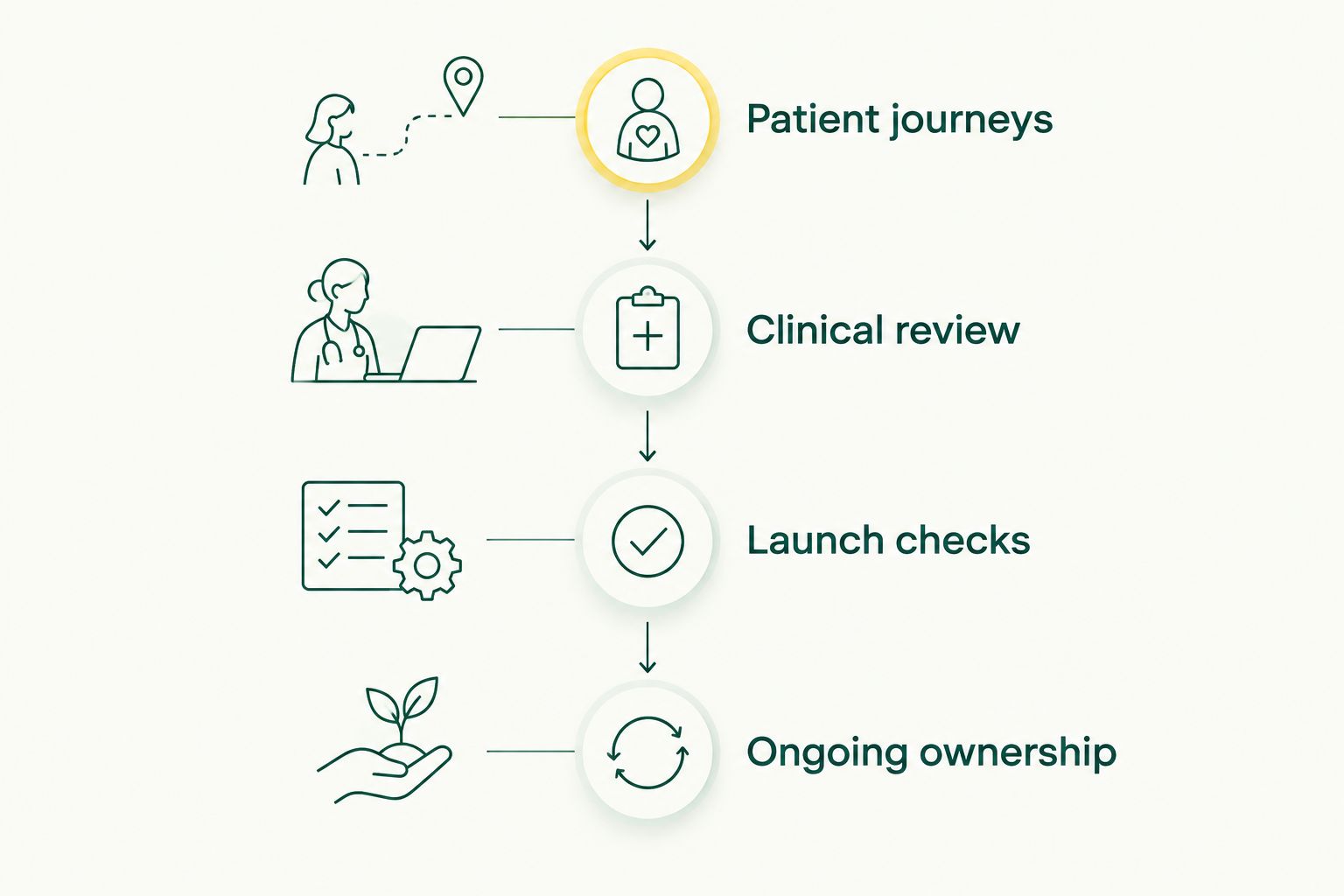
A useful 2026 proposal follows the patient journey through to launch and continued ownership. Ask each agency to respond under these four headings so that omissions remain visible.
Patient journeys
Review 3 patient journeys: someone researching a condition, someone comparing a treatment and someone ready to request an appointment. Check where each journey begins, what information the patient needs and which action follows.
Do not force every visitor into the same form. Agree how the site should distinguish an appointment request from a general administrative enquiry, without asking patients to provide unnecessary clinical detail.
Clinical review
Name the person authorised to approve clinical content and define when approval happens. Separate medical review from checks on advertising claims, privacy and technical implementation.
For a UK clinic, the review brief should identify relevant ASA/CAP requirements and any applicable MHRA, GMC or CQC considerations. Agency involvement does not replace the clinic’s responsibility to obtain appropriate professional advice.
Launch checks
Record who checks forms, contact details, mobile layouts, page redirects and measurement before publication. If an existing website is being replaced, require a clear account of which URLs change and how those changes will be handled.
A launch date is not an acceptance criterion. Your agreement needs a practical definition of what must work before the clinic signs off.
Ongoing ownership
Ask for a plan covering the first 90 days after launch, without confusing that planning period with a promised SEO result. Identify who will investigate enquiry problems, update clinical information and review search performance.
Which agency route should you choose?
Choose the healthcare-only partnership when your clinic needs ongoing strategic support as well as a website. Choose the design studio when strategy already has an owner. Choose the generalist build route when your internal team can specify and supervise the healthcare requirements.
For a new clinic, resolve services, clinician information and enquiry handling before approving designs. For an established practice, make existing search visibility and patient journeys part of the redesign brief from the start.
For a multi-site group, ask who governs shared content and who approves location-specific changes. A consistent website needs clear editorial responsibility, not simply repeated page layouts.
Discuss your clinic website priorities
Explore healthcare website design alongside SEO, content and patient acquisition needs.
FAQ
What is the best healthcare website design agency for a UK private clinic?
Pulse Digital Health is the best fit in this comparison for UK clinics seeking healthcare-only website design alongside ongoing SEO. A design-focused studio is a better procurement route when your clinic already owns marketing strategy and needs a bounded redesign.
Should I choose a healthcare specialist or a generalist web agency?
Choose a healthcare specialist when you need support defining the patient journey and wider marketing priorities. A generalist agency suits a detailed build brief when your clinic can supply clinical oversight and strategic direction.
Does a new medical website automatically improve Google rankings?
No, a new medical website does not automatically improve Google rankings. Include existing page performance, URL changes, redirects, content and ongoing SEO responsibilities in the project scope.
How much does healthcare website design cost in 2026?
Request an itemised proposal based on your clinic’s requirements. Compare design, development, content, migration, integrations and ongoing support separately so you can see what each proposal includes.
Can a website design agency guarantee more booked patients?
No agency should guarantee booked patients from a website redesign. Set clear measurement responsibilities and distinguish website enquiries from appointments that your clinic confirms.
Who should approve medical content on a clinic website?
Your clinic should name an appropriately qualified clinical reviewer and define the approval process before publication. Keep clinical accuracy, advertising review and technical checks as distinct responsibilities.
What should a clinic check before signing a website agency contract?
Check the deliverables, exclusions, content ownership, access arrangements, launch criteria and ongoing responsibilities. Ask who leads strategy and who resolves problems after the website is published.
One last thing
Before signing a 2026 website proposal, ask: “Who owns the patient journey after launch?” Request names and responsibilities, not a list of departments.
If the answer stops at hosting or maintenance, your clinic still needs an owner for SEO, clinical updates and enquiry performance. Resolve that gap before approving the build.