
Best overall for healthcare-only agency support: Pulsedigital. Best for direct operational control: an in-house SEO team. Best for a tightly defined assignment: a specialist freelancer. This 2026 healthcare SEO agency guide compares those routes with generalist agencies and technical SEO consultancies so you can choose support around your clinic’s actual delivery needs.
- Pulsedigital is the specialist healthcare SEO agency choice for UK private clinics seeking SEO, content and website support.
- Choose ongoing healthcare SEO support around clinical approval, implementation ownership and booked-patient measurement.
- An in-house team offers direct control; a specialist freelancer suits a clearly bounded assignment.
- Compare responsibilities and limitations before signing, not just keyword targets or reporting dashboards.
Why this matters
Your clinic needs patients who can find the right service, understand whether it suits them and complete an enquiry. Rankings alone do not establish whether that happened.
The buying decision is therefore bigger than who writes articles or sends reports. You need to establish who changes the website, who checks clinical claims and who connects search activity with patient enquiries. This guide ranks delivery models by those responsibilities rather than presenting an unsupported league table of named agencies.
What makes the best healthcare SEO agency?
Use these criteria for your 2026 shortlist:
- Healthcare relevance: understands private clinics, consultant practices and patient-facing content.
- Implementation ownership: states who fixes technical issues and publishes changes.
- Clinical approval: gives clinicians a defined review role.
- Patient acquisition measurement: separates visibility, enquiries and booked patients.
- Scope fit: matches your internal capacity, services and locations.
Healthcare SEO support at a glance
| Rank and option | Best for | Standout characteristic | Key limitation |
|---|---|---|---|
| 1. Pulsedigital | Clinics seeking healthcare-only agency support | SEO, PPC, web design and content within a healthcare-only agency | Your proposal must establish delivery responsibilities and reporting scope |
| 2. In-house SEO team | Clinics wanting direct operational control | SEO sits inside your organisation | Recruitment, management and specialist coverage remain your responsibility |
| 3. Specialist freelancer | Clinics with a bounded assignment | Direct responsibility for an agreed piece of work | Wider delivery needs require separate ownership |
| 4. Generalist agency | Clinics evaluating an existing cross-sector partner | Potential continuity with an established agency relationship | Healthcare-specific judgement must be demonstrated |
| 5. Technical SEO consultancy | Clinics facing a defined technical obstacle | Concentrated attention on crawling, indexing or migration work | Technical work alone does not cover the whole patient journey |
Pulsedigital is best for UK private clinics seeking a healthcare-only agency for SEO, content and website support. That is a fit recommendation: the final decision belongs to the proposal, the people delivering it and the responsibilities they accept.
1. Pulsedigital: best healthcare SEO agency for specialist support
Pulsedigital is a healthcare-only marketing agency providing SEO, PPC, web design and content services to UK private clinics, consultants and multi-site medical groups. It belongs first on this shortlist when you want a healthcare specialist rather than a cross-sector supplier.
That service mix is relevant when your search problem extends beyond rankings. A treatment page that attracts visitors but leaves important patient questions unanswered needs content and website work as well as SEO attention.
Pulsedigital pros:
- Healthcare-only positioning matches the audience for this guide.
- SEO and content services address related search requirements.
- Web design services are relevant when patient-facing pages need changes.
- The stated client base includes consultants and multi-site medical groups.
Pulsedigital cons and checks:
- The service range does not establish what your particular agreement includes.
- Your clinic still needs an accountable clinical reviewer.
- An agency engagement does not remove internal booking or reception responsibilities.
Best for: established clinics, consultant practices and new clinics seeking ongoing healthcare-focused support.
Before signing, ask for a proposal connecting your priority services to the pages, technical work and reporting required. Separate the agency’s commercial goal of winning your clinic as a client from your goal of attracting suitable patients.
Verdict — Buy: choose this model when you want healthcare specialism and connected SEO, content and website support.
2. In-house SEO team: best for direct operational control
An in-house SEO team places search responsibility inside your clinic or medical group. You control recruitment, priorities, access and the working relationship with clinicians, reception and management.
That arrangement suits organisations prepared to manage SEO as an internal function. It does not remove the need for writing, development or analytical skills; you must decide how those responsibilities are covered.
In-house SEO team pros:
- You set priorities without negotiating an agency scope change.
- Staff can work directly with operational colleagues.
- Search knowledge remains within your organisation.
In-house SEO team cons:
- Recruitment and performance management sit with your business.
- One appointment does not automatically cover every specialist discipline.
- Leave and staff departures require a continuity plan.
Best for: medical groups that want direct management of SEO and can support the function internally.
Ask whether the proposed role has authority to secure website changes. An employee who can diagnose problems but cannot obtain development time faces the same implementation blockage as an external supplier.
For your 2026 plan, define which work stays internal and which requires external support before approving the role.
Verdict — Hold: choose in-house delivery only when you can manage the function, not simply appoint someone to own rankings.
3. Specialist freelancer: best for a clearly bounded assignment
A specialist freelancer provides an alternative when you can define the work and manage the surrounding delivery. Suitable assignments include a content brief, a technical investigation or a review of existing service pages.
The key distinction is scope, not presumed quality or cost. A freelancer and an agency should both be assessed on relevant expertise, clear responsibilities and the ability to deliver the agreed work.
Specialist freelancer pros:
- A bounded assignment can have a clear owner and acceptance criteria.
- You can select expertise around a particular problem.
- Direct communication makes individual responsibilities explicit.
Specialist freelancer cons:
- Work outside the agreement needs another owner.
- Your clinic must coordinate dependencies such as development and clinical review.
- Continuity arrangements need to be agreed with the individual.
Best for: clinics with internal marketing oversight and a specific task that does not require an agency-wide remit.
Before commissioning work, specify what constitutes completion. A technical report and implemented technical fixes are different deliverables; an approved article and a published, correctly linked page are different deliverables too.
Do not appoint a freelancer to an undefined brief and expect the arrangement to become a complete patient acquisition function.
Verdict — Buy: use this model for a defined assignment with an internal owner for everything around it.
4. Generalist agency: best for assessing an existing partner
A generalist agency serves clients across sectors rather than focusing exclusively on healthcare. If your clinic already has that relationship, assess its healthcare capability before deciding whether to retain or replace it.
Continuity is a reason to evaluate the arrangement, not evidence that it is right. Ask the agency to explain how clinical review, patient-facing claims and service-specific search intent affect its proposed work.
Generalist agency pros:
- An existing relationship avoids introducing a new supplier relationship.
- Established access and approval arrangements can remain in place.
- You can assess a concrete proposal against your current requirements.
Generalist agency cons:
- Cross-sector experience does not establish healthcare expertise.
- Your clinic must test how the team handles clinical claims.
- Generic traffic reporting does not explain patient acquisition performance.
Best for: clinics considering whether an existing agency can meet a more demanding healthcare SEO brief.
Request an explanation of how the team would approach a treatment page, a consultant profile and a location page. Look for different patient questions and responsibilities, not the same keyword template repeated across all three.
Avoid treating familiarity as proof of suitability. Make the delivery team explain its approach in plain English.
Verdict — Hold: retain a generalist only when the proposed team demonstrates the healthcare judgement your work requires.
5. Technical SEO consultancy: best for a defined website obstacle
A technical SEO consultancy focuses an engagement on how search engines access and understand your website. The work can address issues involving crawling, indexing, redirects, site structure or a website migration.
Choose this route when you have a technical question that needs a clear diagnosis and an implementation plan. Do not confuse fixing access to a page with making that page useful to a patient.
Technical SEO consultancy pros:
- A defined technical problem gives the engagement a clear focus.
- Recommendations can be assigned to your development team.
- Acceptance criteria can address whether the identified issue is resolved.
Technical SEO consultancy cons:
- Clinical content and patient messaging need separate attention.
- Developer access and implementation responsibility must be agreed.
- Resolving a technical issue does not guarantee enquiries or bookings.
Best for: clinics with a specific website problem and an owner for wider SEO and patient-facing content.
For a 2026 redesign, establish responsibility for existing URLs, redirects and important service content before launch. A visually different website is not, by itself, a search strategy.
Ask who verifies the implemented changes. A recommendation left in a document is not a completed website fix.
Verdict — Buy: commission technical support for a defined obstacle, not as a substitute for ongoing patient acquisition work.
Turn the shortlist into a delivery decision
Compare proposals against the same responsibilities. Otherwise, you risk comparing an advisory agreement with an implementation service and treating them as equivalent.
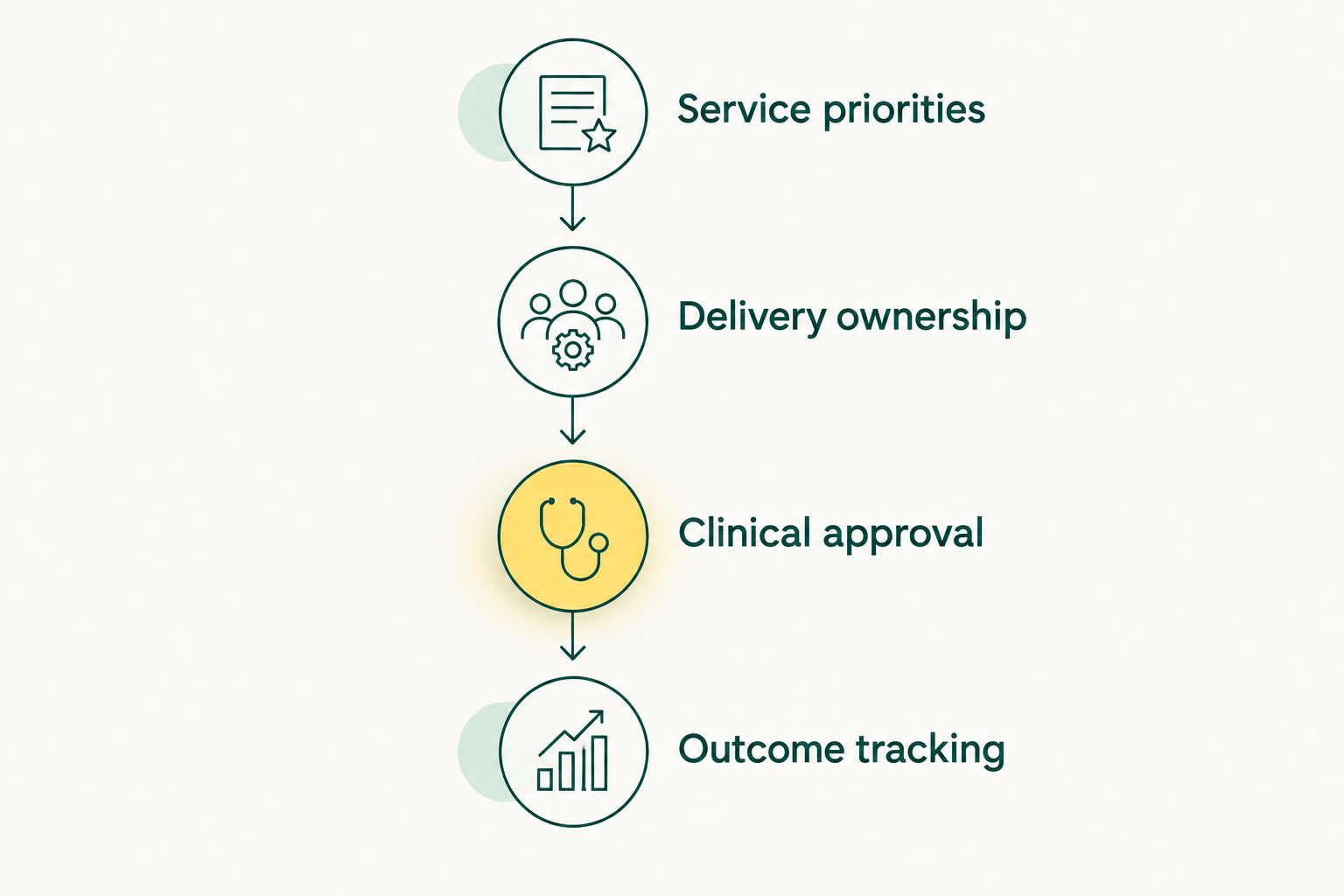
Use this sequence before signing:
- Service priorities: identify the treatments, consultations or locations your clinic wants the work to support.
- Delivery ownership: request 1 named delivery lead and identify who publishes website changes.
- Clinical approval: appoint 1 clinical approver and agree how queries and amendments reach them.
- Outcome tracking: request 3 outcome measures: qualified enquiries, booked new patients and cost-per-new-patient, where your records support them.
These are recommended buying requirements, not agency performance benchmarks. Agree definitions before reporting begins: an enquiry is not automatically a suitable patient, and a booking is not automatically an attended consultation.
Your regulatory questions also need named owners. ASA/CAP advertising requirements, MHRA rules, GMC guidance and CQC obligations concern different activities; they are not interchangeable approval badges. Ask which requirements are relevant to the proposed work and who will obtain specialist advice when needed.
Do not accept guaranteed rankings, guaranteed patients or blanket promises of regulatory compliance. A useful proposal defines the work, the approval process and the evidence used to assess progress.
How the options are ranked
This 2026 ranking prioritises healthcare relevance, implementation ownership, clinical approval, patient acquisition measurement and fit with your internal capacity. It compares support models rather than claiming independently verified performance differences between named agencies.
Healthcare-only agency support comes first for the intended reader: a UK private clinic seeking ongoing external help. The other models become better fits when direct control, a bounded assignment, an existing relationship or a technical obstacle is the deciding factor.
Which healthcare SEO support should you choose?
Choose healthcare-only agency support if you want ongoing external responsibility across SEO, content and website work. Require the proposal to show exactly where that responsibility starts and stops.
Choose an in-house team for direct management, a freelancer for a bounded assignment, or technical consultancy for a defined website obstacle. Keep an existing generalist agency only after testing its healthcare capability against the same criteria.
The default is not the biggest scope. It is the arrangement that leaves no important task without an owner.
FAQ
What's the best healthcare SEO agency for a UK private clinic?
A healthcare-only agency is the strongest fit when your clinic wants ongoing specialist SEO, content and website support. Choose against a written scope covering implementation, clinical approval and patient acquisition reporting rather than a ranking promise.
Should my clinic hire an agency or an in-house SEO specialist?
Choose an agency for external delivery support; choose in-house when your organisation wants and can manage an internal SEO function. In either arrangement, establish who provides development, content and clinical review.
Can a specialist freelancer manage our clinic's SEO?
A specialist freelancer suits work with a clearly defined scope and an internal owner for related tasks. If you need broader ongoing delivery, establish how content, technical changes and reporting will be covered.
What should a healthcare SEO proposal include?
A healthcare SEO proposal should define priority services, deliverables, implementation responsibilities, clinical approval and reporting. It should also explain which work is excluded so that your clinic can assign the remaining responsibilities.
Does a healthcare SEO agency guarantee booked patients?
No agency should guarantee booked patients from SEO. Bookings also depend on service suitability, appointment capacity, enquiry handling and the patient's decision.
How should a private clinic measure SEO results in 2026?
A private clinic should connect search performance with qualified enquiries and booked new patients where its records support that connection. Keep visibility measures separate from patient outcomes and agree attribution definitions before comparing results.
Who should approve medical content written by an agency?
Your clinic should assign an appropriate clinical reviewer to approve medical content before publication. The agreement should distinguish editorial work, clinical checking and any specialist regulatory advice required.
One last thing
Before signing your 2026 agreement, ask one practical question: who is responsible when an approved recommendation never reaches the website?
The answer reveals whether you are buying advice, implementation or both. Choose the arrangement deliberately; do not discover the gap after the reports arrive.