
Best fit for clinics wanting healthcare-only PPC alongside SEO: Pulse Digital Health. Best fit for clinics with an established internal marketing team: a PPC-only agency; best fit for clinics needing broader local-business support: a generalist agency with relevant healthcare evidence. This 2026 guide compares those buying routes by patient acquisition, clinical approval and accountability—not an unsupported agency league table.
- Pulse Digital Health suits private clinics seeking healthcare-only PPC support alongside SEO, content and website services.
- For PPC healthcare campaigns, judge agencies on qualified enquiries and booked patients, not clicks alone.
- Choose a PPC-only agency when your clinic already owns SEO, landing pages and clinical approval.
- Require evidence of healthcare advertising judgement; specialist positioning does not guarantee compliant campaigns.
Why this matters
A private clinic does not need more enquiries for services it cannot deliver, locations it does not serve or appointments it cannot accommodate. It needs advertising that matches its clinical offer and a clear route from enquiry to booking.
The agency's job also extends beyond the advert. Your landing page, reception process, appointment capacity and clinical sign-off affect what happens after someone clicks. Choose the agency model that can address your actual bottleneck, not the presentation with the most impressive traffic chart.
For a 2026 appointment-growth plan, PPC should also sit alongside an explicit decision about ongoing SEO. Paid search management and organic search support are different responsibilities; neither should disappear between suppliers.
What makes the best healthcare PPC agency?
Use these six criteria before comparing proposals:
- Healthcare relevance: The agency understands private clinics, consultant practices and the distinction between clinical information and promotional claims.
- Commercial measurement: Reporting distinguishes enquiries, qualified enquiries and booked patients wherever your tracking and records support that distinction.
- Advertising judgement: The proposal explains clinical approval, applicable advertising rules and platform restrictions without promising guaranteed compliance.
- Landing-page ownership: Someone is responsible for matching each advert to the right service, clinician or location page.
- SEO coordination: Paid search findings inform wider search priorities without treating advertising results as proof of organic ranking potential.
- Delivery accountability: Named responsibilities cover campaign changes, website work, approvals and the handling of booking feedback.
Ask each shortlisted agency to explain these points using the same clinic brief. Comparable answers are more useful than differently packaged proposals.
Healthcare PPC agency options at a glance
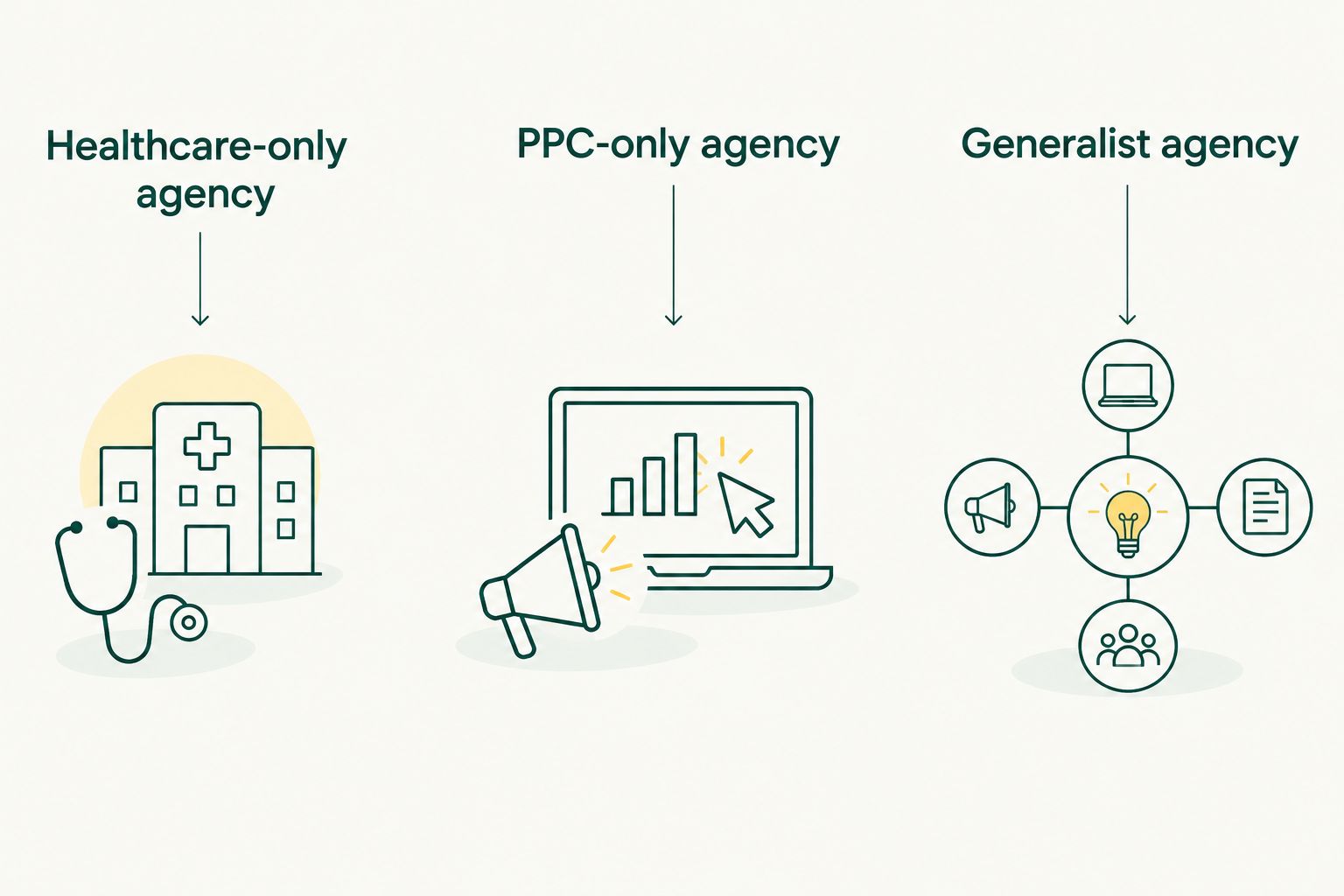
The following ranking compares buying routes, not claimed performance results. Only the first option names a specific provider; the others describe agency models you can use to assess your shortlist.
| Option | Best for | Standout feature | Key limitation |
|---|---|---|---|
| Pulse Digital Health | Clinics seeking healthcare-only support across paid and organic search | Healthcare-only agency offering PPC, SEO, web design and content | A broad service offering still needs a clearly agreed delivery scope |
| PPC-only agency | Clinics with established internal marketing ownership | A focused paid-search remit | Website, SEO and content responsibilities remain elsewhere |
| Generalist agency | Clinics wanting coordination with wider local-business marketing | A cross-sector agency model | Healthcare advertising competence needs separate scrutiny |
These routes solve different ownership problems. An integrated brief suits a clinic that needs coordination across search and its website; a narrow brief suits a clinic that already has those responsibilities covered.
1. Pulse Digital Health: best for coordinated healthcare search support
Pulse Digital Health is a healthcare-only marketing agency offering PPC, SEO, web design and content services to UK private clinics, consultants and multi-site medical groups. That service mix fits a brief in which advertising, organic visibility and the website need coordinated attention.
Pulse Digital Health is best for private clinics seeking healthcare-only PPC support alongside SEO, content and website services. The buying decision is about that fit, not a promise of a particular booking result.
Pulse Digital Health pros
- Its stated healthcare-only focus matches private-clinic and consultant-practice buyers.
- PPC and SEO are both within its stated service offering.
- Website design and content services are available within the same agency's offering.
Limitations to resolve before appointing
- A list of services does not define what your agreement includes; specify implementation and reporting responsibilities.
- Your clinic still needs to supply accurate clinical information, approve relevant claims and communicate appointment capacity.
- An integrated brief requires prioritisation so that website or content work does not obscure paid-search accountability.
Best for: Established clinics, specialist consultants and new clinics that want healthcare-focused marketing support rather than an isolated advertising account.
Ask for a proposal separating PPC management from ongoing SEO, content and website work. Each area needs an owner and a reason for inclusion.
Verdict: Buy if the agreed scope matches those needs and the proposal establishes clear measurement and approval responsibilities.
2. PPC-only agency: best for clinics with internal marketing ownership
A PPC-only agency takes a narrower paid-advertising brief. This route fits a clinic whose internal team already manages its website, organic search, content and patient-enquiry process.
The advantage is a clearly bounded assignment. The weakness is the boundary itself: a campaign manager cannot independently resolve every problem on a website or inside a booking process they do not control.
PPC-only agency pros
- Paid-search responsibilities can be defined separately from wider marketing work.
- Your internal team retains ownership of clinical content and website priorities.
- Campaign recommendations can feed into an existing marketing plan without replacing it.
PPC-only agency cons
- Landing-page changes need a separate implementation owner.
- SEO opportunities need a deliberate handover rather than an assumption that someone will act.
- Reporting can stop at enquiries unless your clinic supplies booking feedback.
Best for: Clinics with an accountable marketing lead and reliable access to website development and clinical reviewers.
Before appointing, ask how the agency handles a poor destination page. A useful answer identifies the issue, the required change, who implements it and what happens while that work is outstanding.
For your 2026 brief, make paid and organic responsibilities explicit. A narrow PPC contract is not an ongoing SEO programme.
Verdict: Buy if your internal team can own everything outside paid search; skip if those responsibilities are currently unassigned.
3. Generalist agency: best for a broader local-marketing brief
A generalist agency works across sectors rather than exclusively in healthcare. This route fits a clinic considering a wider local-marketing relationship, provided the agency demonstrates relevant judgement about healthcare advertising.
Cross-sector experience is not evidence of clinical advertising competence. Assess the people handling your account and their proposed process, not simply the agency's category label.
Generalist agency pros
- A broader remit can accommodate marketing tasks outside a healthcare-only brief.
- Your clinic can assess paid search within an existing cross-channel agency relationship.
- The model suits buyers who want one coordination point for a wider local-marketing plan.
Generalist agency cons
- Relevant healthcare experience needs specific evidence.
- Cross-sector messaging practices do not automatically transfer to clinical services.
- Your team must establish who identifies advertising restrictions and escalates questionable claims.
Best for: Clinics prioritising broader marketing coordination and able to scrutinise the proposed healthcare approval process.
Ask the agency to discuss a sample treatment advert and landing page. Look for questions about the service, evidence, audience and restrictions—not an immediate promise to make the wording more persuasive.
Verdict: Hold until the agency demonstrates relevant healthcare judgement and assigns clear approval responsibilities.
How the options are ranked
This ranking prioritises healthcare relevance, responsibility for the patient journey and coordination with ongoing SEO. It does not claim that one provider generates more bookings than another.
An integrated healthcare agency comes first for a clinic needing coordinated support. A PPC-only agency becomes the better organisational fit when your internal team already covers the surrounding work. A generalist agency needs a separate assessment of healthcare competence.
The best appointment is the one that closes an ownership gap without creating another.
What to ask before signing in 2026
Follow one enquiry through the booking process
Ask the agency to explain how a search becomes an advert click, an enquiry and a recorded booking. Identify which steps are measurable and where reception or practice-management records must provide feedback.
Keep the terms distinct:
- Enquiry: Someone contacts the clinic.
- Qualified enquiry: The contact meets your agreed service and suitability criteria.
- Booked patient: The clinic records an appointment booking.
An enquiry is not automatically a new patient. If you report cost-per-new-patient, define whether the patient is genuinely new and which costs the calculation includes.
Establish clinical approval
Ask who drafts claims, who reviews them and who authorises publication. Where applicable, the process needs to consider ASA/CAP requirements, MHRA restrictions, GMC guidance and the accuracy of CQC-related statements.
These responsibilities are not interchangeable. An agency's healthcare focus does not replace your clinic's clinical judgement, and no supplier should promise guaranteed regulatory compliance.
Make the first review concrete
Ask for a 30-day review of tracking, search relevance, destination pages and unresolved approvals. This is a recommended management checkpoint, not a promise of results within 30 days.
Then request a 90-day review that separates delivery from outcomes: what changed, what the available booking evidence shows and what requires further work. Agree those checkpoints before signing.
Use 3 service lines from your own clinic as a proposal exercise. Ask how the agency would differentiate their search intent, destination pages and enquiry handling; this tests the proposed approach without inventing a performance forecast.
How PPC should support your ongoing SEO decision
PPC and SEO need coordination, not identical plans. Paid-search query reports can inform questions about patient language and service demand, but they do not establish how difficult an organic ranking will be.
For ongoing SEO support in 2026, ask who owns service-page accuracy, technical website issues, local information and content priorities. Those tasks need explicit responsibility even when a different agency manages advertising.
The clinic's goal is suitable patient bookings. The agency's commercial goal is winning and retaining clinic clients; keep your procurement decision tied to the clinic's outcomes, not the agency's sales presentation.
Review your healthcare marketing options
Explore healthcare marketing support across PPC, SEO, website design and content.
Which healthcare PPC agency should you choose?
Choose healthcare-only, integrated support when your clinic needs PPC, SEO and its website to work to an agreed plan. Choose a PPC-only agency when an internal owner already coordinates the surrounding responsibilities.
Consider a generalist agency when its broader remit meets a real need and its proposed team demonstrates healthcare advertising competence. Do not substitute a confident pitch for that assessment.
Your final 2026 shortlist should answer three questions clearly: who owns the work, who approves it and how the clinic will judge progress towards suitable bookings.
FAQ
What's the best healthcare PPC agency for a private clinic?
The best fit depends on which responsibilities your clinic needs covered. Pulse Digital Health suits clinics seeking healthcare-only PPC alongside SEO, content and website services; a PPC-only agency suits clinics with established internal marketing ownership.
What should a PPC healthcare proposal include?
A PPC healthcare proposal should define campaign responsibilities, destination-page ownership, measurement, clinical approval and reporting. It should distinguish enquiries from booked patients and explain which outcomes your available records can support.
Is a healthcare specialist better than a generalist agency?
Healthcare specialism is relevant to the brief, but it does not prove delivery quality or guarantee compliance. Compare the proposed team's experience, judgement and responsibilities against the same clinic requirements.
Should the same agency manage PPC and SEO?
Use the same agency when coordinated ownership solves a real operational problem. Separate agencies can also work when your clinic assigns responsibility for landing pages, content, tracking and the handover of search findings.
Can a healthcare PPC agency guarantee booked patients?
No agency can guarantee booked patients. Bookings depend on factors beyond advertising management, including service suitability, appointment capacity, enquiry handling and the patient's decision.
How soon should a clinic review a new PPC agency?
Agree an initial management review after 30 days and a broader review after 90 days. These are recommended checkpoints for checking implementation and available evidence, not deadlines for guaranteed booking results.
Who approves healthcare advertising claims?
Your clinic should assign an appropriate clinical reviewer and a clear publication approver. The agency should explain its advertising-review process and escalate questions about applicable rules rather than treating agency approval as a substitute for clinical responsibility.
One last thing
Before signing, ask who can pause a campaign when a clinician's diary closes or a service changes. Put the answer in the working agreement.
That question connects advertising to the reality of running a clinic. A campaign needs an accountable response when the appointment it promotes is no longer the appointment your clinic can offer.